Readings for Sunday 26 July 2026
19 Abib 1742
Third Sunday of Abib
Vespers Psalm & Gospel
From the Psalms of our father David the prophet and the king, may his blessings be with us all. Amen.
Psalms 52 : 9,8
| 9 | I will praise You forever, Because You have done it; And in the presence of Your saints I will wait on Your name, for it is good. |
| 8 | But I am like a green olive tree in the house of God; I trust in the mercy of God forever and ever. |
Blessed is he who comes in the Name of the Lord. Our Lord, God and Savior Jesus Christ, Son of the Living God, unto Him be the glory forever, Amen.
Stand in the fear of God and listen to the Holy Gospel. A reading from the Holy Gospel according to our teacher Saint Luke the Evangelist. May His Blessings be with us all. Amen.
Luke 14 : 7 - 15
| 7 | So He told a parable to those who were invited, when He noted how they chose the best places, saying to them: |
| 8 | "When you are invited by anyone to a wedding feast, do not sit down in the best place, lest one more honorable than you be invited by him; |
| 9 | and he who invited you and him come and say to you, "Give place to this man,' and then you begin with shame to take the lowest place. |
| 10 | But when you are invited, go and sit down in the lowest place, so that when he who invited you comes he may say to you, "Friend, go up higher.' Then you will have glory in the presence of those who sit at the table with you. |
| 11 | For whoever exalts himself will be humbled, and he who humbles himself will be exalted." |
| 12 | Then He also said to him who invited Him, "When you give a dinner or a supper, do not ask your friends, your brothers, your relatives, nor rich neighbors, lest they also invite you back, and you be repaid. |
| 13 | But when you give a feast, invite the poor, the maimed, the lame, the blind. |
| 14 | And you will be blessed, because they cannot repay you; for you shall be repaid at the resurrection of the just." |
| 15 | Now when one of those who sat at the table with Him heard these things, he said to Him, "Blessed is he who shall eat bread in the kingdom of God!" |
Glory be to God forever.
↑ Top of Page ↑
Matins Psalm & Gospel
From the Psalms of our father David the prophet and the king, may his blessings be with us all. Amen.
Psalms 134 : 1
| 1 | Behold, bless the LORD, All you servants of the LORD, Who by night stand in the house of the LORD! |
Blessed is he who comes in the Name of the Lord. Our Lord, God and Savior Jesus Christ, Son of the Living God, unto Him be the glory forever, Amen.
Stand in the fear of God and listen to the Holy Gospel. A reading from the Holy Gospel according to our teacher Saint Luke the Evangelist. May His Blessings be with us all. Amen.
Luke 24 : 1 - 12
| 1 | Now on the first day of the week, very early in the morning, they, and certain other women with them, came to the tomb bringing the spices which they had prepared. |
| 2 | But they found the stone rolled away from the tomb. |
| 3 | Then they went in and did not find the body of the Lord Jesus. |
| 4 | And it happened, as they were greatly perplexed about this, that behold, two men stood by them in shining garments. |
| 5 | Then, as they were afraid and bowed their faces to the earth, they said to them, "Why do you seek the living among the dead? |
| 6 | He is not here, but is risen! Remember how He spoke to you when He was still in Galilee, |
| 7 | saying, "The Son of Man must be delivered into the hands of sinful men, and be crucified, and the third day rise again."' |
| 8 | And they remembered His words. |
| 9 | Then they returned from the tomb and told all these things to the eleven and to all the rest. |
| 10 | It was Mary Magdalene, Joanna, Mary the mother of James, and the other women with them, who told these things to the apostles. |
| 11 | And their words seemed to them like idle tales, and they did not believe them. |
| 12 | But Peter arose and ran to the tomb; and stooping down, he saw the linen cloths lying by themselves; and he departed, marveling to himself at what had happened. |
Glory be to God forever.
↑ Top of Page ↑
Divine Liturgy
Pauline Epistle
Paul, the servant of our Lord Jesus Christ, called to be an apostle, appointed to the Gospel of God. A reading from the Epistle of our teacher Paul to the Timothy.
May his blessings be with us. Amen.
1 Timothy 6 : 3 - 16
| 3 | If anyone teaches otherwise and does not consent to wholesome words, even the words of our Lord Jesus Christ, and to the doctrine which accords with godliness, |
| 4 | he is proud, knowing nothing, but is obsessed with disputes and arguments over words, from which come envy, strife, reviling, evil suspicions, |
| 5 | useless wranglings of men of corrupt minds and destitute of the truth, who suppose that godliness is a means of gain. From such withdraw yourself. |
| 6 | Now godliness with contentment is great gain. |
| 7 | For we brought nothing into this world, and it is certain we can carry nothing out. |
| 8 | And having food and clothing, with these we shall be content. |
| 9 | But those who desire to be rich fall into temptation and a snare, and into many foolish and harmful lusts which drown men in destruction and perdition. |
| 10 | For the love of money is a root of all kinds of evil, for which some have strayed from the faith in their greediness, and pierced themselves through with many sorrows. |
| 11 | But you, O man of God, flee these things and pursue righteousness, godliness, faith, love, patience, gentleness. |
| 12 | Fight the good fight of faith, lay hold on eternal life, to which you were also called and have confessed the good confession in the presence of many witnesses. |
| 13 | I urge you in the sight of God who gives life to all things, and before Christ Jesus who witnessed the good confession before Pontius Pilate, |
| 14 | that you keep this commandment without spot, blameless until our Lord Jesus Christ's appearing, |
| 15 | which He will manifest in His own time, He who is the blessed and only Potentate, the King of kings and Lord of lords, |
| 16 | who alone has immortality, dwelling in unapproachable light, whom no man has seen or can see, to whom be honor and everlasting power. Amen. |
The grace of God the Father be with you all. Amen.
↑ Top of Page ↑
Catholic Epistle
A Reading from Epistle of St. James . May his blessings be upon us. Amen.
James 3 : 1 - 12
| 1 | My brethren, let not many of you become teachers, knowing that we shall receive a stricter judgment. |
| 2 | For we all stumble in many things. If anyone does not stumble in word, he is a perfect man, able also to bridle the whole body. |
| 3 | Indeed, we put bits in horses' mouths that they may obey us, and we turn their whole body. |
| 4 | Look also at ships: although they are so large and are driven by fierce winds, they are turned by a very small rudder wherever the pilot desires. |
| 5 | Even so the tongue is a little member and boasts great things. See how great a forest a little fire kindles! |
| 6 | And the tongue is a fire, a world of iniquity. The tongue is so set among our members that it defiles the whole body, and sets on fire the course of nature; and it is set on fire by hell. |
| 7 | For every kind of beast and bird, of reptile and creature of the sea, is tamed and has been tamed by mankind. |
| 8 | But no man can tame the tongue. It is an unruly evil, full of deadly poison. |
| 9 | With it we bless our God and Father, and with it we curse men, who have been made in the similitude of God. |
| 10 | Out of the same mouth proceed blessing and cursing. My brethren, these things ought not to be so. |
| 11 | Does a spring send forth fresh water and bitter from the same opening? |
| 12 | Can a fig tree, my brethren, bear olives, or a grapevine bear figs? Thus no spring yields both salt water and fresh. |
Do not love the world or the things in the world. The world passes away, and its desires; but he who does the will of God abides forever. Amen.
↑ Top of Page ↑
Acts of the Apostles
The Acts of our fathers the apostles, may their blessings be with us. Amen.
Acts 18 : 12 - 23
| 12 | When Gallio was proconsul of Achaia, the Jews with one accord rose up against Paul and brought him to the judgment seat, |
| 13 | saying, "This fellow persuades men to worship God contrary to the law." |
| 14 | And when Paul was about to open his mouth, Gallio said to the Jews, "If it were a matter of wrongdoing or wicked crimes, O Jews, there would be reason why I should bear with you. |
| 15 | But if it is a question of words and names and your own law, look to it yourselves; for I do not want to be a judge of such matters." |
| 16 | And he drove them from the judgment seat. |
| 17 | Then all the Greeks took Sosthenes, the ruler of the synagogue, and beat him before the judgment seat. But Gallio took no notice of these things. |
| 18 | So Paul still remained a good while. Then he took leave of the brethren and sailed for Syria, and Priscilla and Aquila were with him. He had his hair cut off at Cenchrea, for he had taken a vow. |
| 19 | And he came to Ephesus, and left them there; but he himself entered the synagogue and reasoned with the Jews. |
| 20 | When they asked him to stay a longer time with them, he did not consent, |
| 21 | but took leave of them, saying, "I must by all means keep this coming feast in Jerusalem; but I will return again to you, God willing." And he sailed from Ephesus. |
| 22 | And when he had landed at Caesarea, and gone up and greeted the church, he went down to Antioch. |
| 23 | After he had spent some time there, he departed and went over the region of Galatia and Phrygia in order, strengthening all the disciples. |
The word of the Lord shall grow, multiply, be mighty, and be confirmed, in the holy Church of God. Amen.
↑ Top of Page ↑
Synaxarium
Day 19 of the Blessed Coptic Month of Abib.
May God make it always received, year after year, with reassurance and tranquility, while our sins are forgiven by the tender mercies of our God my fathers and brothers. Amen.
The Nineteenth Day of the Blessed Month of Abib
The Martyrdom of Sts. Bidaba, Bishop of Qift, Anba Andrew, and Anba Christodoulas.
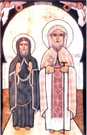
On this day, of the year 284 A.M., which is the first year of the martyrs, the great saint Anba Bidaba, and his companion, the priest Andrew, his nephew, and St. Christodoulas, were martyred. Anba Bidaba, who was known by El-Gawhary, was bishop of the city of Qift, in Upper Egypt, during the days of the governor Arianus, and the reign of Emperor Diocletian
This great saint was born in the city of Armant to Christian parents who raised him since his young age in a Christian manner. His mother's sister had a son, called him Andrew and raised him in a Christian way. Andrew and his cousin Bidaba liked each other and decided to forsake the world. They eagerly read the Bible and religious books, they widened their comprehension and they became the authority of their times in piety and godliness. When Bidaba was ten years old he had memorized most of the religious books and spiritual teachings. They fasted two days at a time without food or water and when they ate, they only ate bread and salt, accompanied by fervent prayers day and night
One day while they were thinking about the vanity of this world, they decided to leave their families and live lives of seclusion in a deserted place. They went to the Eastern mount where they found Anba Eisak. This saint comforted and strengthened them to endure the hardships to receive the Eternal Life. Anba Eisak blessed them and commanded them to go to another place where they could live a life of solitude and spend all their time in worship. Then he told Anba Bidaba, "O, my son you shall shepherd the flock of Christ, many toils, tribulations and great persecutions will befall you." He told Andrew, "You also shall receive a crown, after your strife, that has been prepared for you."
They left Anba Eisak and went to the western side and built for themselves a cell. They had full knowledge and excellent skills in transcribing the holy books. They did that for little money to support their life and donated whatever was left to the poor and the needy. The bishop of this district came, once he heard about them, and ordained Anba Bidaba a priest and Andrew a deacon. They went to a church in one of the nearby cities once every forty days to celebrate the Divine Liturgy. One day they went to the church, and found the bishop there so Anba Bidaba stood in reverence and respect for the bishop. The bishop was sitting on his chair looking at St. Bidaba, and he was amazed to see the face of the Saint shining as the moon, and light emanating from him and on his head was a crown of gold decorated with precious stones. The bishop asked them to bring this saint and his companion Andrew. When they came to see him, he asked them to stay with him, but Anba Bidaba refused, preferring to live in the barren desert than live under the care of the bishop. Nevertheless, St. Andrew accepted to stay under the care of the bishop. Anba Bidaba returned to his cell weeping and saying, "I ask you O my Lord Christ to consecrate that place for Thy self that Your Name might be mentioned in it for ever." Then he left that place and went to another area further away. A few days later the bishop sent a messenger to the cell seeking the Saint but he did not find him. The bishop built a church in the name of this saint in that place and consecrated it on the thirteenth day of the month of Kiyahk. As for St. Bidaba, he went to the church taking a different way to pray. Many signs and miracles were wrought by his hands, and he increased in grace and blessing.
When his fame spread, and his name was acclaimed, many came to him and he healed their spiritual and physical sicknesses. The people asked the bishop Anba Tadros saying, "We ask you O our father to bring for us Anba Bidaba to be blessed by him and to stay among us for a period of time." The bishop did as they asked.
When Anba Bidaba came to the city of Bahgourah, district of Nagaa-Hammady, there was a man, whose name was John, who had only one daughter, who was attractive. His neighbors were furious against him, and used sorcery against her, for they asked her father to give her in marriage to one of their sons, but he refused. But, the Saint Anba Bidaba prayed for her, and she became as normal as she had been, and God nullified the witchcraft away from her. When her family saw their daughter healed by the hand of that saint, they came and kneeled before him, and kissed his hands thanking him for his act. The Saint told them, "Thank God and praise Him, for the grace that healed your daughter was not from me." They left him rejoicing.
When it was Sunday and the people were gathered in the church, they brought the Saint to the bishop who promoted him to Hegumen (Archpriest). He stayed with the bishop for nine days then went back to the mountain. Later on, the bishop of Qift departed, so the people of the area gathered and unanimously decided to nominate Abba Bidaba to be ordained in his place. They decided to go to Pope Peter the First (The seal of martyrs and the 17th Patriarch) to ordain him a bishop for them. The angel of the Lord appeared to the Pope in a vision and told him, "Go to Upper Egypt and bring the Archpriest Bidaba and ordain him a bishop for the city of Qift, for the Lord has chosen him." Early next morning the delegations of the believers came asking to ordain the honorable father Bidaba a bishop. The Pope sent four priests with a letter to the Saint. When they arrived, he received the letter from them and read in it, "It is written in the Holy Bible whoever hears from you, heard from Me, and whoever refuses you, refused Me." St. Bidaba cried bitterly and said, "Woe to me the poor sinner for the Devil wishes my perishing." Then he prayed saying, "Let it be according to Your Will, O Lord, and not according to mine, for You know that I am weak, powerless, and incapable of handling this position."
The messengers of the Pope embarked with him to the Pope. The Pope asked the people of the parish, "Who do you chose to be a bishop over you." They unanimously answered saying, "Abba Bidaba, for he is worthy for this honorable ministry." The Pope ordained him a bishop for the diocese of Qift. While he was laying his hand over his head, a voice from heaven said, "Worthy, worthy, worthy O Bidaba to receive this position." He remained with the Pope for a few days, during which he celebrated the Divine Liturgy. Whenever he placed his hand over the chalice to make the sign of the cross, the wine changed to blood. The Pope was amazed and looked at the saint and said, "Truly you are chosen from God." He asked the Pope to allow him to go to his parish. He embarked in a sailing boat, which had a handicapped man, that did not walk for twenty-two years. While he was getting aboard the boat the saint's leg slipped and stepped over the leg of that handicapped man. The man's legs were healed and he jumped up immediately praising God. All those in the ship praised God and asked the saint to remember them in his prayers and to bless them.
Many miracles were wrought by his hands during his journey. When they arrived safely at their hometown, the people of the parish went out with candles, crosses, censers, olive branches and palm branches, in their hands to receive him. They took him in a procession until they entered the church and he sat on his Episcopal Chair. He lived in asceticism, as he had lived before, praying continually day and night. His food was bread and salt and his dress was a cloth of hair. He performed many signs and wonders.
When Emperor Diocletian incited persecution against the Christians, governor Arianus came to upper Egypt, and seized the Christians. He threw them in prisons, and tortured them severely, along his way until he arrived at Esna. When the saint Anba Bidaba knew of that, he was kindled with a spiritual zeal and said, "Is it right for me to remain here, and my brothers, the Christians facing unbearable tortures? No, I must go there and die with them as a sacrifice of faith." He called the people and celebrated a pontifical Liturgy and after he administered to them the Holy Mysteries, he preached to them saying, "We must not be afraid to be martyred in the Name of the Lord Christ, not be afraid of hot fire, arrows or spears, and swords drawn against our necks. As also you need to be merciful to the poor, comfort the grieved, be vigilant in your prayers and fasting for they are your aid by which you can overcome obstacles and cast out the devil that weaken your faith in the Lord Christ." The bishop preached and strengthened his people, and after he made the sign of the holy cross over them, blessed them and bid them farewell saying, "I shall go to be martyred by the hand of Arianus the governor." The people cried and wept for his departure, but he comforted and strengthened them.
Afterwards, he left them and went to the city of Esna, accompanied by the blessed Fr. Andrew and Anba Christodoulas. The bishop Anba Bidaba looked at them and said, "Where are you going?" They replied, "We are going with you to die for our love of Christ." The bishop looked at them and saw the grace of God had come down upon them and their faces shining like the moon. He strengthened and commanded them to be steadfast in their faith in Christ. He told them, "On this night I saw in a vision an angel who had with him three crowns and I asked him to whom did these belong? He said one for you, one for your cousin, and one for Christodoulas, so let us go to Esna."
When they arrived at Esna, they saw a multitude of Christians, bishops, priests, deacons, and believers, being tortured. The governor brought them and ordered them to raise incense for the gods, but they cried saying, "We are Christians and we do not fear you, O infidel governor. We do not worship these defiled gods that were made by human hands. Our God that we worship, is in heaven, the creator of everything with the Word of His might, visible and invisible, to Whom is the Glory, Honor, and Worship with His good Father and the Holy Spirit, now and forever and unto the age of ages, Amen." When the Governor heard their words and saw their steadfastness, he ordered to cut their heads off with the sword.
During that time, Anba Bidaba was standing, watching the Christians being tortured, and he saw angels coming down from heaven, and in their hands, crowns of light for the heads of those who were martyred, and raising them to the heaven with great honor and glory. The Bishop and his companions went forward and cried out saying, "We are Christians, and we believe in Jesus Christ the Lord of all creatures and the God of every power." The Governor asked them, "From where are you?" Then he asked the bishop about his name. The Bishop replied, "I am the lowly Bidaba." The Governor said, "I think you are the bishop of this land, but I am amazed at how you could dare to say these words. Did you not dread my retaliation and fear my authority and majesty? Have you not seen the torture that has been prepared for those who confess that Name?" The Saint answered courageously and said, "Have you not heard the saying of the Book by the mouth of Lord Jesus Christ, 'Therefore whoever confesses Me before men, him I will also confess before My Father who is in heaven. But whoever denies Me before men, him I will also deny before My Father who is in heaven.' (Mat. 10:32-33) Because of this promise, we confess Our Lord Jesus Christ to the utter most breath." The Governor tried, by promising him money and position once and then threatening him in other time, to change his council and his faith in the Lord Christ, and when he failed, he ordered that the Saint be imprisoned in one of the prisons.
When the saints in prison saw him, they saluted him and said, "Would you vanquish for us this governor, for you have been given the victory from the Lord of hosts." While they were talking about the greatness and goodness of God, the Archangel Michael appeared to the Bishop and said, "Hail to you O honored one, let your soul rejoice today for God has accepted all your toil, asceticism, and struggle for the sake of faith. You shall receive three crowns: the first, for your worship and asceticism since your young age, the second, for shepherding the flock on the straight path, and the third, for your martyrdom. You shall be crowned with these crowns with glory and honor to receive the heavenly glories." The angel ascended, and the Saint stood and prayed saying, "Hear me O Father the Pantocrator, may my petition rise before You, and You smell it as a sweet incense that pleases You, I ask You O father for Thy people and saints who do mercy for the poor, and accept my soul in Your hands that I may receive the heavenly glories, for to You is the Glory, Honor, and Worship with Your Good Father and the Holy Spirit, forever. Amen."
When he finished his petition he saw the Lord our Savior and around Him the angels coming to comfort him, saying, "My consolation O beloved Bidaba, I am with you." Then the magnificent procession ascended to heaven. On the next morning, the governor ordered all the prisoners brought to the place where the people of the city gathered. When they saw the saints they cried saying, "We are Christians and we believe in one God, the God of Anba Bidaba." The governor became enraged and brought the Saint and those who were with him and ordered their heads cut off. The blood flowed like streams. The skies were filled by the pure angels welcoming the spirits of those righteous saints. St. Bidaba, St. Andrew, and St. Christodoulas received the crown of eternal life.
May their blessings be with us. Amen.
The Martyrdom of St. Pantaleemon, the Physician.
This day also marks the martyrdom of the honorable St. Pantaleemon, the
Physician. This saint was born in the city of Ta'madan. His father, whose name
was Astochius (Asturius), was pagan, and his mother, whose name was Unala
(Ulana), was Christian. They taught him the medical profession.
A priest lived near their house, and every time Pantaleemon passed by him,
and the priest saw his stature, his comeliness, his knowledge, and his wisdom,
he was sorrowful for him for he was away from God. The priest entreated God in
his prayers, to guide Pantaleemon to the way of salvation. Having repeated his
petition to God for Pantaleemon's sake, the Lord told him in a vision that he
would believe through him. The priest rejoiced, and started to speak to him
whenever he passed before him, until a friendship grew between them. The priest
started to explain to him the corruptness of idol worshipping and the nobility
of the Faith of the Lord Christ and the noble life of its followers. He also
told him about those who believe in Christ, and the signs and wonders wrought by
their hands.
When Pantaleemon, the Physician, heard that, he rejoiced and desired to
perform these signs to perfect his medical profession. One day, he was passing
through the market-place of the city, and he saw a man, whom a serpent had
bitten, lying on the ground and the serpent was standing up before him. He said
to himself, "I will put to test the words of my teacher, the priest, who told
me, 'If you believe in the Lord Christ, you shall work miracles in His Name.'"
He drew near that man, and prayed a long prayer, asking the Lord Christ to
manifest His Power in healing that man, and in killing that serpent, so that it
might not harm anyone else. When he finished his prayer, the man rose up alive,
and the serpent fell down dead. Pantaleemon's faith increased; he went to the
priest, who baptized him, and he went on practicing medicine.
One day a blind man came to Pantaleemon that he might heal him, but his
father sent him away. The Saint asked him, " Who was asking for me?" His father
replied, "It was a blind man, and you can not heal him." The Saint told him,
"You shall see the glory of God." He called the blind man back, and asked him,
"If you can see will you believe in the God Who shall heal your eyes?" The man
said, "Yes, I will believe." The Saint prayed over him a long and a profound
prayer, and then he laid his hand upon the eyes of the blind man, and said, "In
the Name of the Lord Christ receive your sight." Straightway, he received his
sight and believed in the Lord Christ. When his father saw that, he also
believed. The saint brought them to the priest who baptized them.
When his father departed, the Saint set his slaves free and gave all his
money to the poor. He treated the sick freely, and asked them to believe in
Christ. The other physicians were jealous of him, and they laid accusation
against him, the priest and many others who had believed, before the Emperor. He
brought them and threatened to torture them if they did not deny the Lord
Christ. When they did not yield to his threats, he tortured them severely then
cut off their heads. The Emperor exaggerated in torturing St. Pantaleemon, he
cast him to the lions which did not harm him, and the Lord strengthened and
healed him. Finally, the Emperor ordered to cut off his head and he received the
crown of martyrdom.
May his prayers be with us. Amen.
The Departure of Pope Youanis X, 85th Patriarch of Alexandria.
On this day also, of the year 185 A.M. (July 13th, 1369 A.D.) Pope Youanis X, 85th Patriarch of Alexandria, departed. He was known by El-Mo'ataman the Syrian, and he was from Damascus, Syria. He was a righteous and knowledgeable man. He was enthroned on the 12th of Bashans, 179 A.M. (May 7th, 1363 A.D.). He remained on the throne for six years, two months, and seven days. He departed in peace and was buried in Old Cairo beside Simon the shoe maker.
May his prayers be with us and Glory be to God forever. Amen.
↑ Top of Page ↑
Divine Liturgy Psalm & Gospel
From the Psalms of our father David the prophet and the king, may his blessings be with us all. Amen.
Psalms 145 : 17 - 18
| 17 | The LORD is righteous in all His ways, Gracious in all His works. |
| 18 | The LORD is near to all who call upon Him, To all who call upon Him in truth. |
Blessed is he who comes in the Name of the Lord. Our Lord, God and Savior Jesus Christ, Son of the Living God, unto Him be the glory forever, Amen.
Stand in the fear of God and listen to the Holy Gospel. A reading from the Holy Gospel according to our teacher Saint Luke the Evangelist. May His Blessings be with us all. Amen.
Luke 9 : 10 - 17
| 10 | And the apostles, when they had returned, told Him all that they had done. Then He took them and went aside privately into a deserted place belonging to the city called Bethsaida. |
| 11 | But when the multitudes knew it, they followed Him; and He received them and spoke to them about the kingdom of God, and healed those who had need of healing. |
| 12 | When the day began to wear away, the twelve came and said to Him, "Send the multitude away, that they may go into the surrounding towns and country, and lodge and get provisions; for we are in a deserted place here." |
| 13 | But He said to them, "You give them something to eat." And they said, "We have no more than five loaves and two fish, unless we go and buy food for all these people." |
| 14 | For there were about five thousand men. Then He said to His disciples, "Make them sit down in groups of fifty." |
| 15 | And they did so, and made them all sit down. |
| 16 | Then He took the five loaves and the two fish, and looking up to heaven, He blessed and broke them, and gave them to the disciples to set before the multitude. |
| 17 | So they all ate and were filled, and twelve baskets of the leftover fragments were taken up by them. |
Glory be to God forever.
↑ Top of Page ↑